 United States
Seeing “Nicotine Alternative” on Vape Products? Here’s What It Actually Means
Why Are You Seeing “Nicotine Alternative” on Vape Products?
If you’ve looked through newer vape products recently, you may have noticed some unfamiliar wording.
Instead of simply saying nicotine, a product may mention Nixodine, a nicotine alternative, or another branded formulation.
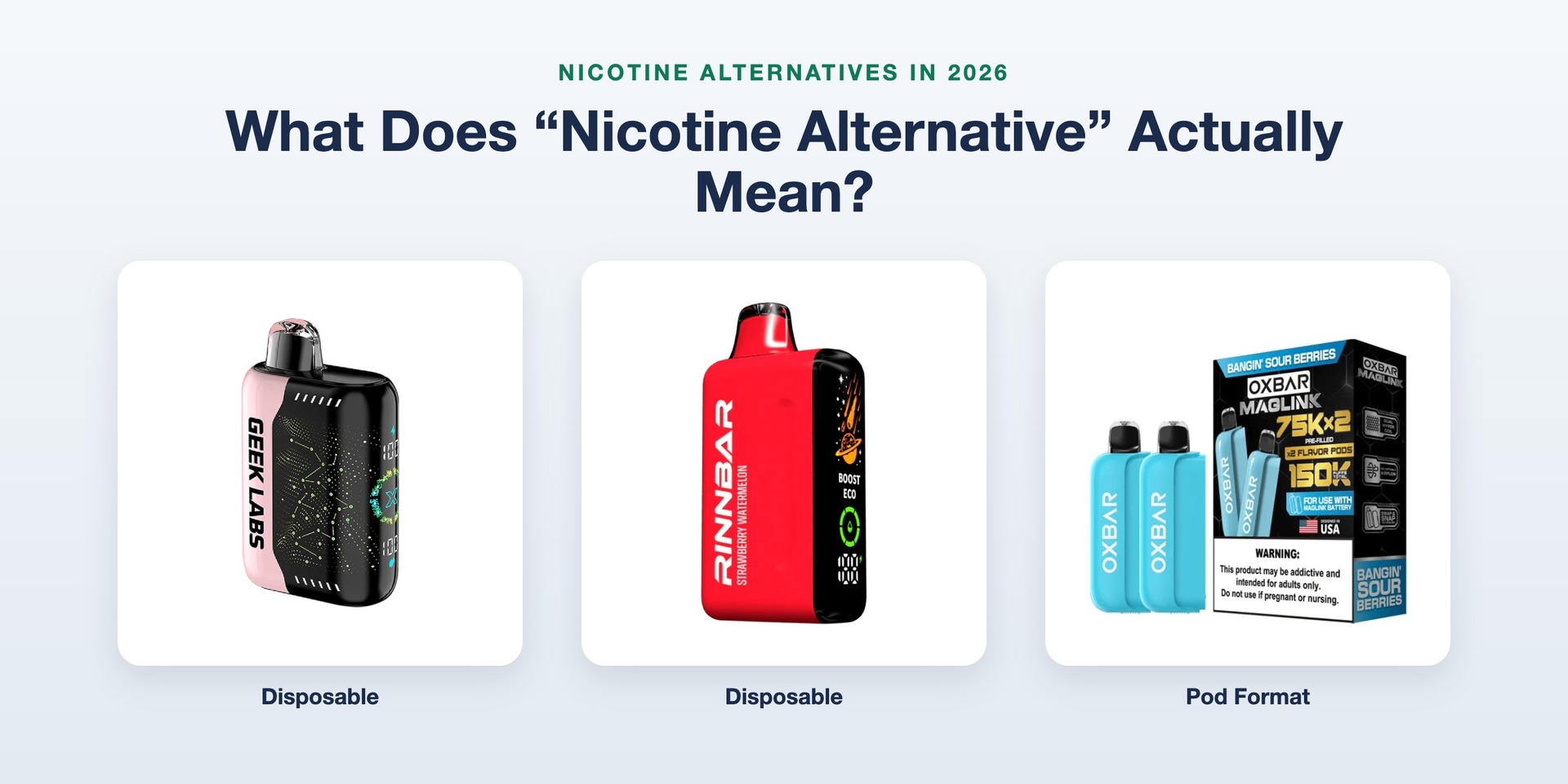
That language is becoming more visible across the market. Vapor Empire’s current new releases, for example, include BLVK NIXODINE ZERO, several Pachamama + Nixodine e-liquids, and products such as the Geek Labs Pulse X Nixodine Disposable.
So if you’re wondering:
“Is this basically nicotine with a different name?”
the answer is:
Not necessarily.
And that distinction is exactly why these newer labels deserve a closer look.
What Does “Nicotine Alternative” Actually Mean?
“Nicotine alternative” is not the name of one standardized ingredient.
It is a broad marketing description that can be used for products formulated with substances intended to occupy a similar product category to nicotine, while being chemically different from conventional nicotine.
That could involve a nicotine analog such as 6-methylnicotine, a different compound such as nicotinamide, or a proprietary formulation marketed under a brand name.
A 2026 review of emerging nicotine analog products notes that terms such as Nixamide, Nixodine, Nixotine, Metatine, and NoNic6 have been used across different formulations and commercial products (PubMed Central (PMC)).
So the most important thing to remember is:
The phrase “nicotine alternative” does not tell you exactly what chemical is in the product.
You still need to look at the ingredient or formulation information.
Is Nixodine the Same Thing as Nicotine?
No — you should not assume that it is.
“Nixodine” has been used as a commercial name around newer nicotine-alternative formulations, but research shows that the chemistry behind products marketed under names like Nixodine has not always been straightforward.
A peer-reviewed paper from Duke and Yale researchers reported that early products marketed as Nixodine, Nixamide, or Nixotine used nicotinamide as a main ingredient. Later formulations were described as including combinations of nicotinamide and the nicotine analog 6-methylnicotine (PubMed).
That means “Nixodine” should be treated as a product or formulation name — not as a precise synonym for nicotine or 6-methylnicotine.
This matters when you’re shopping.
For example, the Geek Labs Pulse X Nixodine Disposable is specifically marketed as using Nixodine rather than a conventional nicotine e-liquid.
If you see that kind of wording, the right question is not:
“How strong is the nicotine?”
It is:
“What exactly is the active ingredient in this formulation?”
What Is 6-Methylnicotine?
6-methylnicotine, sometimes shortened to 6-MN, is a chemical analog of nicotine.
That means its structure is similar to nicotine, but it is not chemically identical.
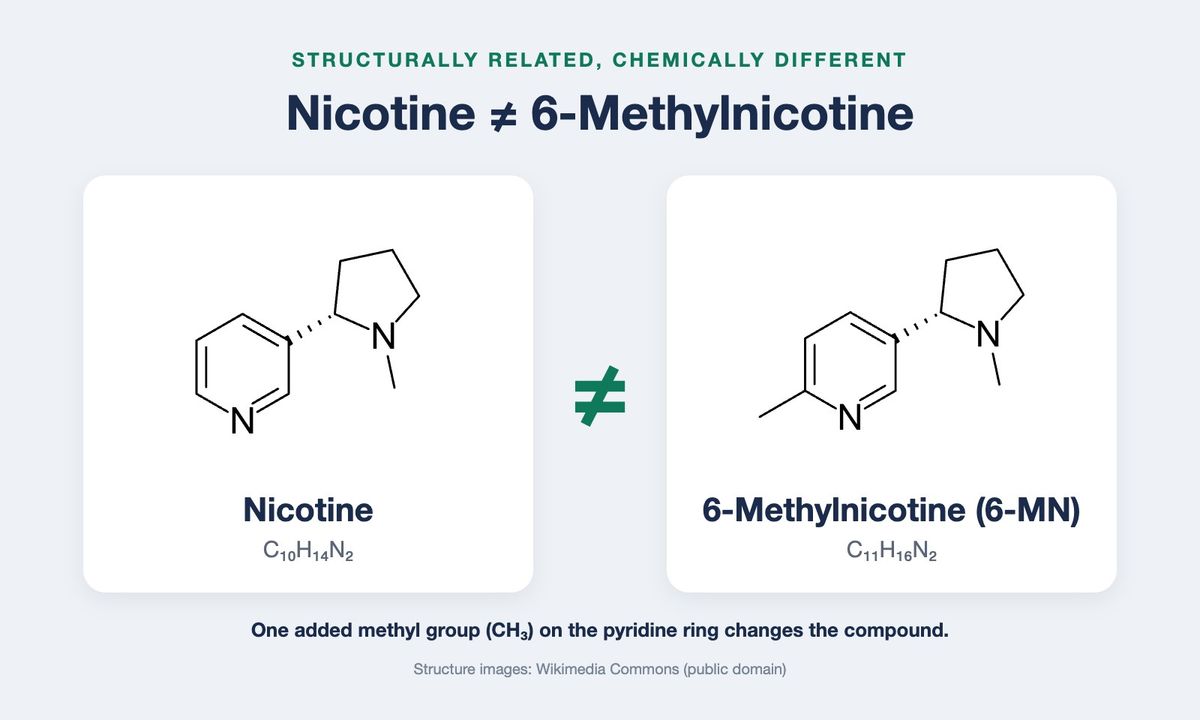
FDA’s chemical substance database lists (S)-6-methylnicotine as a defined chemical substance with the molecular formula C₁₁H₁₆N₂ (precisionFDA).
Recent research has focused on 6-MN because some newer vape and oral products have used it in place of conventional nicotine.
Truth Initiative describes 6-methylnicotine as a nicotine analog that can interact with several of the same nicotinic receptors in the brain (Truth Initiative).
That similarity does not mean the two substances should be treated as interchangeable.
They are different compounds with different toxicological and regulatory questions.
Is 6-Methylnicotine Safer Than Nicotine?
There is currently no good basis for assuming that.
A 2025 laboratory study found that aerosols generated from 6-methylnicotine formulations produced more reactive oxygen species than the nicotine comparison and showed greater cytotoxicity in human bronchial epithelial cells under the conditions tested. The authors concluded that 6-MN could not be considered a safer nicotine alternative based on those findings (PubMed).
A separate 2026 toxicology study used a 3D human airway model to compare nicotine and 6-methylnicotine aerosols. Researchers found different toxicological effects between the two and again concluded that 6-MN should not be characterized as a safer nicotine alternative (PubMed).
Those are laboratory studies, not long-term human outcome studies.
So the more accurate takeaway is:
Research on 6-methylnicotine is still developing, and current evidence does not support assuming it is safer simply because it is different from nicotine.
Why Does the Ingredient Label Matter So Much?
Because product names do not always tell the full story.
Researchers analyzing newer nicotine-analog e-cigarettes have found discrepancies between product labels and measured contents.
One study examining products containing 6-methylnicotine and nicotinamide found substantial differences between declared and measured concentrations. Some products marketed around nicotinamide also contained measurable 6-methylnicotine even when it was not clearly identified on the label (PubMed Central (PMC)).
A related constituent-analysis study also reported variability in products containing nicotine analogs and highlighted the difficulty consumers may face when trying to understand exactly what a newer formulation contains (PubMed Central (PMC)).
That does not mean every nicotine-alternative product is mislabeled.
It means you should avoid assuming that a branded term tells you everything you need to know.
“Tobacco-Free,” “Nicotine-Free,” and “Nicotine Alternative” Are Not the Same Thing
These labels can sound similar, but they describe different things.
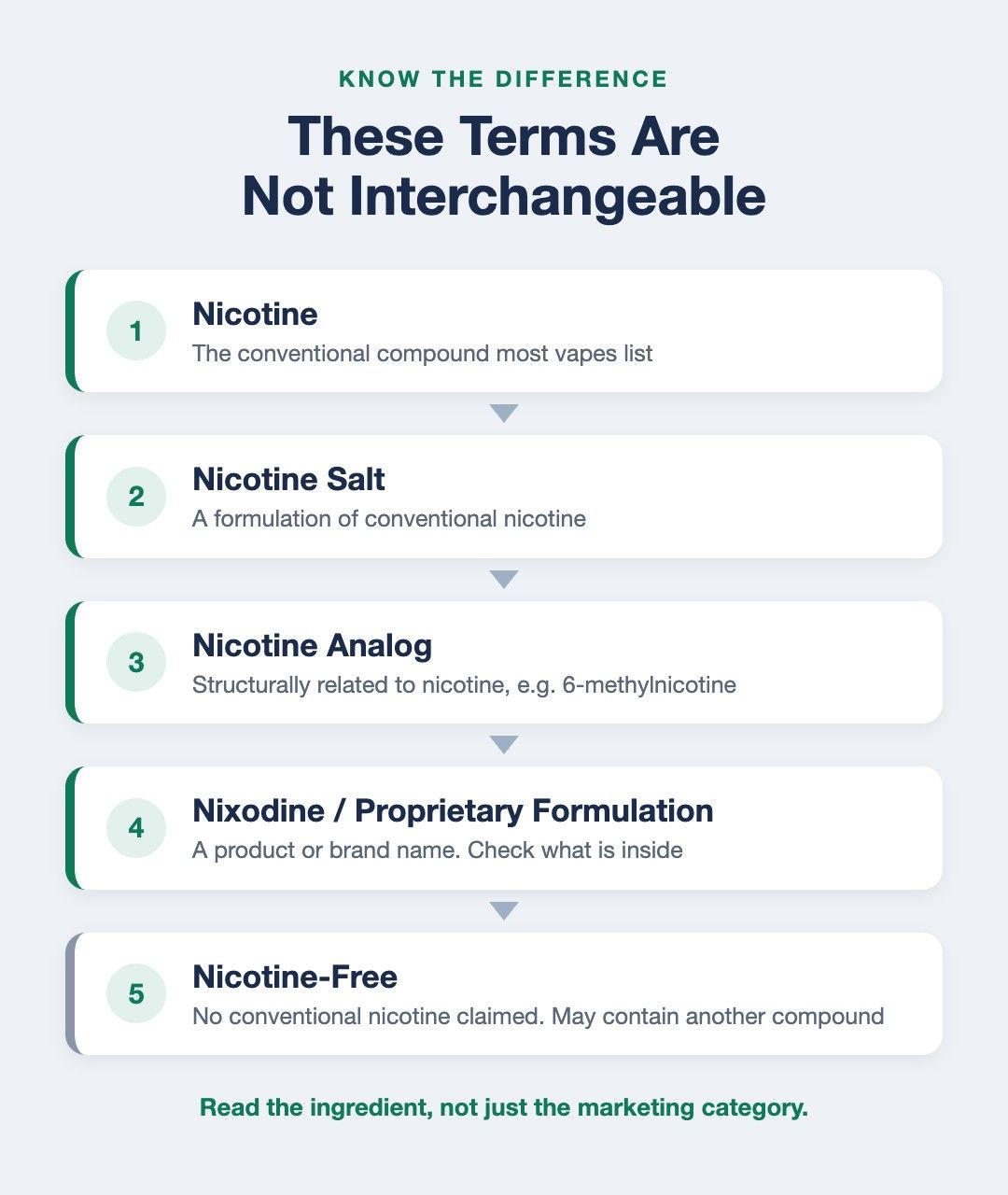
| Label | What It Generally Tells You |
|---|---|
| Tobacco-free | The product is not made with tobacco leaf |
| Nicotine-free | The product claims not to contain conventional nicotine |
| Nicotine alternative | The product may contain another formulation or compound instead of conventional nicotine |
| Nicotine analog | A chemical structurally related to nicotine |
| Nicotine salt | A formulation of conventional nicotine |
| Nicotine pouch | An oral nicotine product rather than a vape |
The wording matters.
A product can be tobacco-free and still contain nicotine.
A product marketed as nicotine-free may contain another active compound.
And a nicotine alternative may not necessarily be a single standardized ingredient.
If you want a refresher on conventional nicotine formats, Vapor Empire’s Nicotine: Understanding Its Origins, Effects, and Safety Measures and E-Liquid Components guides provide useful background on traditional nicotine and nicotine salts.
Why Are Nicotine Alternatives Appearing Now?
The nicotine market has been expanding into more product categories.
Adult shoppers may now see:
- traditional freebase nicotine
- nicotine salts
- nicotine pouches
- zero-nicotine vape products
- nicotine analogs
- branded nicotine-alternative formulations
Vapor Empire’s current assortment reflects some of that expansion, with newer Nixodine-labeled e-liquids and disposables appearing alongside traditional nicotine products and nicotine pouches.
Researchers have also linked the emergence of nicotine analog products to regulatory differences between conventional nicotine and chemically distinct analogs.
A 2026 review describes manufacturers introducing compounds including 6-methylnicotine and nicotinamide formulations in products marketed as alternatives to conventional nicotine (PubMed Central (PMC)).
Truth Initiative similarly notes that nicotine analogs such as 6-MN are appearing in e-cigarettes, pouches, and other products and currently occupy a different regulatory position from products containing nicotine (Truth Initiative).
For shoppers, though, the practical issue is simpler:
There are now more ingredient categories to understand before you buy.
Does “Nicotine Alternative” Mean FDA Authorized?
No.
A product being available for sale, labeled “tobacco-free,” or marketed as a nicotine alternative does not by itself mean FDA has authorized it.
FDA maintains a specific list of authorized e-cigarette products. As of the agency’s current list, 48 e-cigarette products are authorized for marketing in the United States (U.S. Food and Drug Administration).
FDA also continues to publish enforcement priorities for certain unauthorized electronic nicotine delivery systems and nicotine pouch products (U.S. Food and Drug Administration).
The important distinction is:
FDA authorization is product-specific.
It does not transfer automatically to an entire brand, ingredient category, or type of nicotine alternative.
And “FDA authorized” does not mean “FDA approved” in the everyday sense or mean that a product is risk-free.
What Should You Check Before Buying a Nicotine-Alternative Vape?
This is where the label becomes practical.
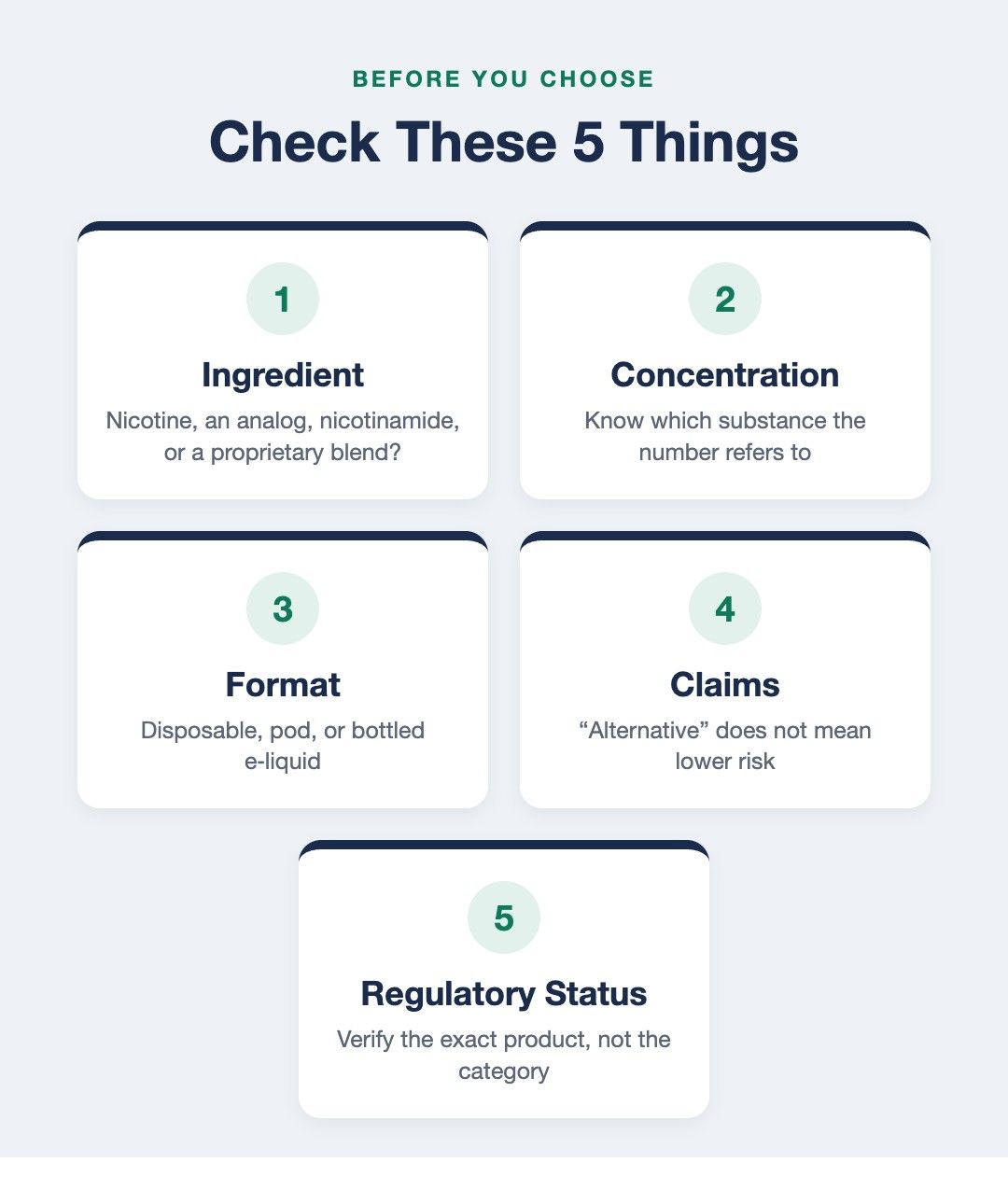
1. Look for the Actual Ingredient
Do not stop at “nicotine alternative.”
Check whether the product identifies:
- Nixodine
- 6-methylnicotine
- nicotinamide
- another named compound
- a proprietary formulation
If the ingredient is unclear, that uncertainty is worth noticing.
2. Check the Concentration
A concentration number is only useful when you know what substance it refers to.
“50mg” of conventional nicotine and a concentration listed for another formulation should not automatically be treated as equivalent.
3. Read the Product Description
The Rinn Bar NIX Nixodine Disposable, for example, is explicitly labeled as a Nixodine product and lists its device specifications separately.
The Oxbar Maglink Nixodine Replacement Pod is another current example showing how Nixodine wording is now appearing in modular pod formats as well.
Those product names are useful cues to read beyond the familiar vape specs.
4. Do Not Assume “Alternative” Means Lower Risk
Different chemistry does not automatically mean safer chemistry.
Current laboratory evidence on 6-MN specifically gives us good reason not to make that assumption (PubMed).
5. Check Regulatory Status Separately
If FDA authorization matters to your decision, verify the exact product using FDA’s current authorized-product information rather than relying on packaging or marketing language (U.S. Food and Drug Administration).
How Are Nicotine Alternatives Different From Nicotine Pouches?
Nicotine pouches are a separate format.
They are oral products that sit between the gum and lip rather than being inhaled through a vape device.
Vapor Empire already covers that category in Nicotine Pouches Are Growing Fast: What Adult Shoppers Should Know.
There is also an important regulatory difference.
FDA has authorized specific nicotine pouch products through its PMTA pathway, including 11 ZYN ULTRA products authorized in August 2026 (U.S. Food and Drug Administration).
Twenty ZYN nicotine pouch products also received modified-risk orders in June 2026 allowing a specific reduced-risk claim compared with cigarettes. Those orders apply only to the named products and authorized claim (U.S. Food and Drug Administration).
Again, the lesson is the same:
Regulatory status follows the specific product — not the entire category.
A Few Nicotine-Alternative Formats You May See
The category is already appearing in several product formats.
Geek Labs Pulse X Nixodine Disposable
This disposable is marketed with Nixodine instead of conventional nicotine and also includes typical modern disposable features such as adjustable airflow, multiple operating modes, a digital display, and USB-C charging.
The important part for this discussion is the ingredient positioning, not the hardware.
Rinn Bar NIX Nixodine Disposable
This product is another example of Nixodine terminology appearing directly in the product name and description.
That makes it easier for shoppers to recognize that they are not looking at a standard nicotine-labelled disposable.
Oxbar Maglink Nixodine Replacement Pod
This shows that nicotine-alternative formulations are not limited to traditional all-in-one disposables.
They are also appearing in replacement-pod formats.
Pachamama + Nixodine E-Liquids
Vapor Empire’s current new-release assortment also includes multiple Pachamama + Nixodine salt e-liquids, showing that the terminology is moving beyond disposables into bottled e-liquid as well.
Together, those examples show why this topic matters now:
“Nicotine alternative” is becoming a product category you may encounter across several vape formats.
What Does Independent Research Still Need to Answer?
A lot.
This is still an emerging area.
Researchers are actively studying questions such as:
- how nicotine analogs are absorbed
- how their potency compares with nicotine
- what compounds form when they are heated
- how accurately products are labeled
- how different analogs affect airway tissue
- how repeated exposure may affect health
- how these products should be regulated
The 2026 review of nicotine analog vapes, pods, and pouches specifically notes that complete safety profiles for compounds such as 6-MN remain incomplete (PubMed Central (PMC)).
Laboratory evidence is growing, but long-term human evidence is much more limited.
That means claims like:
“newer,”
“tobacco-free,”
“nicotine alternative,”
or “synthetic”
should not be treated as shortcuts for determining safety.
What Should Adult Shoppers Take Away?
You do not need to become a chemist every time you shop.
But newer labels do require a little more attention.
When you see “nicotine alternative,” check:
- what ingredient is actually named
- whether it is conventional nicotine, an analog, or another compound
- what concentration is listed
- whether the product description clearly explains the formulation
- whether the product has verified FDA authorization
- whether any safety claims are actually supported
The simplest rule is:
Read the ingredient — not just the marketing category.
That one habit can prevent a lot of confusion.
“Nicotine Alternative” Is a Starting Point, Not the Full Answer
The vape market is becoming more complicated.
Alongside traditional nicotine and nicotine salts, adult shoppers are now seeing Nixodine-branded products, nicotine analogs, zero-nicotine products, nicotine pouches, and other emerging formulations.
Some of those terms describe genuinely different chemistry.
Others are branding terms that require more context.
And research is still catching up.
So when you see a new ingredient name, do not assume it is simply another version of nicotine — or that “alternative” means safer, FDA-authorized, or directly equivalent.
Look at the ingredient.
Read the product description.
Check the evidence.
And if regulatory status matters, verify the specific product rather than the category name.
Learn More About Nicotine Alternatives
Vapor Empire’s nicotine-alternatives guide also covers established non-vape formats such as pouches, gum, lozenges, sprays, and other options.
Related Vapor Empire Guides
- Nicotine Pouches Are Growing Fast: What Adult Shoppers Should Know
- Nicotine Alternatives: Pouches, Gum, and Beyond
- E-Liquid Components: Flavoring, Nicotine Shots, and Bases
- Vapor Empire Information Hub
- Disposable Vapes in 2026: Which Features Actually Matter?
Content Sources
Vapor Empire
Used for current product examples, Nixodine-labeled inventory, internal educational content, and current nicotine-alternative assortment.
U.S. Food and Drug Administration
Used for current authorized-ENDS information, PMTA context, 2026 nicotine-pouch decisions, and the distinction between specific product authorization and broad category claims (U.S. Food and Drug Administration).
Truth Initiative
Used for independent current context on nicotine analogs, 6-methylnicotine, and the emerging regulatory gap around products made with chemically distinct nicotine analogs (Truth Initiative).
Raghu et al. (Rahman Lab) — 2026 Review of Nicotine Analog Products
Toxicity, Chemistry, and Public Health Relevance of Emerging Nicotine Analog Vapes, Pods, and Pouches. Used for chemistry, commercial terminology, emerging formulations, and remaining research gaps (PubMed Central (PMC)).
Effah et al. — 2026 Toxicology Study
A Comparative Toxicological Evaluation of Nicotine and Its Analog 6-Methyl Nicotine in E-Cigarette Aerosol Utilizing a 3D In Vitro Human Respiratory Model. Used for current laboratory evidence comparing nicotine and 6-MN aerosols (PubMed).
Effah et al. — 2025 Toxicology Letters Study
Emerging Nicotine Analog 6-Methyl Nicotine Increases Reactive Oxygen Species in Aerosols and Cytotoxicity in Human Bronchial Epithelial Cells. Used for earlier toxicology evidence on 6-MN aerosols (PubMed).
Jabba & Jordt — Nicotinamide/Nixodine Research
Marketing of Nicotinamide as Nicotine Replacement in Electronic Cigarettes and Smokeless Tobacco. Used to distinguish nicotinamide, Nixodine/Nixamide branding, and 6-methylnicotine-containing formulations (PubMed).
Independent Product-Constituent Studies
Used for evidence that some nicotine-analog products have shown discrepancies between labeled and measured constituents, reinforcing the importance of ingredient transparency.